DIY Pickleball Court: Easy Step-by-Step Setup
You can still hear the ball’s pop against the paddle as the sun dips low. The kids call for one more game. Turning a patch of your yard into a backyard pickleball court means more of these evenings.
Pickleball blends ping-pong, badminton, and tennis into a fast, friendly sport. It’s sweeping across the United States. Whether you want a permanent DIY sports court or a portable setup, you can build a pickleball court that fits your space and budget.
This guide walks you through site selection, measurements, and base preparation. You’ll learn about surface choices like concrete or sports tiles, painting, nets, lighting, and upkeep. If you already have a flat pad, you can repurpose it quickly for low-cost play with marked lines and a portable net.
Keep this as your plan to estimate costs and decide between a permanent backyard pickleball court and a portable option. Follow clear steps to bring your DIY pickleball court to life.
Why Build a Backyard Pickleball Court
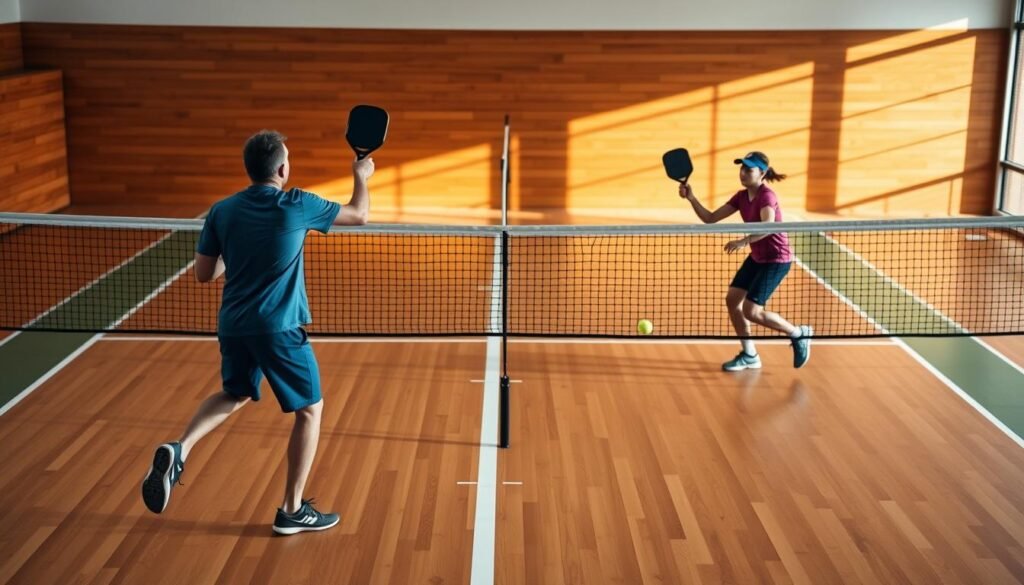
Creating an outdoor pickleball court in your backyard turns unused space into a lively spot. It offers private time for practice, family games, and neighborhood play. You won’t have to worry about scheduling at public courts.
Benefits for family, fitness, and property value
Your homemade pickleball court promotes regular exercise for everyone. Quick games improve heart health, coordination, and social skills. Families often enjoy weekend tournaments and evening games.
Real estate agents say a well-made court can increase your home’s appeal and value. A professionally built court is a big plus for buyers looking for fun features.
Unlimited playtime and hosting opportunities
Having a court at home means you set the schedule. You dodge crowded public courts and weather issues. Portable lights and nets let you play at night and host events easily.
Your home becomes a hub for gatherings, barbecues, and small tournaments. Guests love the entertainment options, making them stay longer.
Cost vs. convenience: permanent court versus portable setup
Building a DIY pickleball court can save you money compared to hiring professionals. A permanent setup costs more upfront, with prices depending on site prep and finishes.
For a budget-friendly option, use portable nets, tape, chalk lines, or modular tiles. You can even repurpose your driveway to create your own DIY pickleball court.
Get quotes for concrete work and compare surface brands like Sherwin-Williams or GatorCourt. Shopping online for nets and gear can also help you stay within budget while building a fun, durable DIY pickleball court that fits your space perfectly.
Site Selection and Orientation for an Outdoor Pickleball Court
Choosing the right location is key for a lasting outdoor pickleball court. Look for a flat, level area with good drainage. Make sure to clear vegetation, remove roots, and get rid of rocks or debris to keep the surface even and safe.
Pickleball court design begins with proper grading. For new courts, start by excavating, grading, and compacting the ground. Use a plate compactor or small grader. Work with your contractor to ensure a slight slope—about 1–2%—for runoff, if needed.
Choosing a flat, level area with proper drainage
Check the site for low spots where water pools after rain. Water can shorten the life of the surface. Install a gravel subbase or French drain to channel water away from the playing area.
Recommended court orientation north-south to reduce sun glare
Orienting the court north–south helps avoid sun glare during morning and evening play. Check local sun paths and note prevailing winds. You might need to rotate the orientation slightly to reduce crosswinds that affect short shots.
Space requirements: standard court and recommended surrounding clearance
When planning your DIY pickleball court, remember that the standard playing surface is 20 feet by 44 feet. For safe movement, allow at least 30 by 60 feet of total space, and if possible, aim for 40 by 64 feet to give players extra room and space for spectators.
If your yard space is limited, consider building a practice or half court. Keeping accurate measurements for the kitchen and service lines ensures your DIY pickleball court meets regulation standards and provides a realistic playing experience.
Use this checklist when choosing your court location: flatness and slope, drainage and soil type, sun and wind patterns, and room for proper clearance. A well-planned DIY pickleball court site leads to better play, safety, and long-lasting results.
Pickleball Court Dimensions and Layout Standards
When building a pickleball court, precise measurements are key. The court is a rectangle, 20 feet wide and 44 feet long. All lines are measured to the outside edge. This ensures fair play and easy refereeing.
Playing surface measurements
The official playing surface is 20 feet wide and 44 feet long. The lines must be 2 inches wide and stand out against the court color. Make sure to measure to the outside edge of the lines for tournament standards.
Non-volley zone, service areas, baselines
The non-volley zone, or kitchen, is 7 feet from the net on each side. It’s marked with 2-inch lines. Players can’t volley in this zone. Service courts are between the kitchen line and the baseline, divided by a centerline for accurate service.
Recommended overall space
A safe area around the court is about 30×60 feet. For better play, aim for a total area of up to 40×64 feet. This space makes the court feel roomy and reduces injuries.
Layout tips for your project
- Draw a full-scale plan before digging to align with property lines and drainage.
- Use a 2-inch tape for all line widths and check color contrast against the surface paint.
- Place net posts centered on baselines and check net height at the center and sidelines to meet standards.
Whether for a community center or your backyard, these standards ensure safe and consistent play. Follow these guidelines to achieve professional results in your pickleball court project.
Preparing the Base: Excavation, Gravel, and Concrete Choices
Before you start, focus on the base steps for a lasting court. Clear the area, remove topsoil and roots, and get rid of debris. Use an excavator for big jobs or a shovel and grader for smaller areas. A level base prevents settling later.
Excavate to 6–8 inches below the surface. This space is for drainage and pavement. Add a 4-inch layer of compacted gravel or stone. Use a plate compactor to make it firm and even. This step reduces frost heave and standing water.
For a concrete court, add reinforcement. Install rebar or wire mesh to prevent cracking. Pour a reinforced slab with a slight slope for runoff. Let it cure for weeks to avoid later problems.
An asphalt court is cheaper and faster to install. It offers a warmer bounce but needs more upkeep. It’s good for those who want to save money upfront.
The surface finish affects play. Concrete provides a consistent bounce with little upkeep. Asphalt needs regular sealcoating and repairs. Choose based on durability, play feel, and costs.
Quick comparison to guide your choice
| Feature | Concrete pickleball court | Asphalt pickleball court |
|---|---|---|
| Initial cost (typical) | $20,000–$35,000 for pro bids with rebar | Lower initial cost per sq ft; more affordable upfront |
| Maintenance | Low; occasional crack repair and reseal every 15–25 years | Higher; resurfacing and sealcoating every ~5 years |
| Durability | High; decades of stable surface with proper installation | Moderate; subject to rutting and oxidation over time |
| Playability | Consistent ball bounce and firm feel | Slightly softer bounce; can vary with temperature and age |
| Drainage needs | Requires slope and good base; concrete tolerates moisture if drained | Depends on base; good gravel layer and compaction are essential |
| Recommended reinforcement | Rebar or wire mesh strongly recommended | Repair fabric and proper base; rebar not used |
Surface Preparation and Moisture Control Before Painting
Getting your court ready means making sure the paint sticks well. New concrete needs time to dry and get rid of moisture. Plan your painting schedule to match the concrete’s curing and moisture levels.
Wait at least 28–40 days for the concrete to cure. Experts say 60–70 days is better to let moisture fully escape. Keep the slab dry and clean during this time to prepare it for painting.
Check moisture levels before painting. Use a probe meter or calcium chloride test to see if it’s low. If it’s high, you need a moisture barrier to protect your paint.
Clean and prepare the surface next. Etching helps paint stick better. Use Max Grip etch and SlipDoctors Non-Slip Floor Cleaner to clean it well.
How long to wait after cleaning depends on the temperature. At 75°F, wait 24 hours. Between 50–60°F, wait 48 hours. Below 50°F, wait at least seven days. If moisture still exists, apply a moisture barrier before painting.
Fix cracks and defects before etching. Use a good concrete filler, let it dry, then sand it smooth. This step helps your court play better for pickleball.
Prime the surface with a good product. Use SlipDoctors Prime Coat or something similar. Apply it in thin, even layers, following the manufacturer’s dry time.
Use the right tools and safety gear. A low-pressure sprayer helps apply the moisture barrier. Long-handled rollers speed up primer coverage. Always wear gloves, a respirator, and goggles when working with chemicals.
Following the right steps—curing, testing, etching, applying a barrier, fixing, and priming—ensures your paint sticks well. This care makes your DIY pickleball court look and play great.
Painting Your Court: Colors, Paint Types, and Line Guidelines
Before you start painting, plan your colors and layout. Choose contrasting colors for the court and lines so they’re easy to see. USA Pickleball suggests a darker main court and a lighter non-volley zone for better visibility and safety.
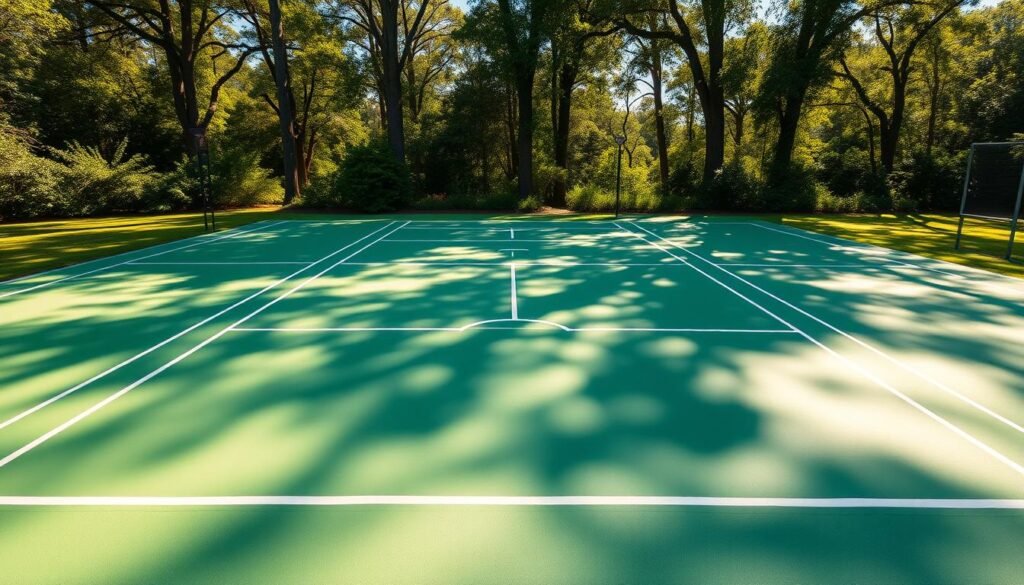
Use anti-slip coatings made for sports surfaces. Brands like Alpha Grip offer paint that’s good for traction and lasts long. Apply two thin coats for a smooth finish without bubbles.
Figure out how much paint you’ll need for a standard court. A single court might need about 15 gallons for the main area and about 1 gallon for the lines. Check the product label for exact coverage rates.
Get the surface ready before painting. Power wash it, let it dry, then apply a primer or moisture barrier as the paint maker suggests. Use Frog Tape or painter’s tape for clean lines.
Paint in a specific order. Start with the main court color, then the kitchen area, and finally the lines. Wait about four hours between coats and follow the drying times for a complete cure.
Pickleball lines must be 2 inches wide. Use white or another color that contrasts well with the court. Use chalk, string, or a laser level to mark the lines before painting.
Remove tape while the paint is still wet for sharp edges. Avoid painting in bad weather to prevent adhesion and finish issues.
You’ll need long-handled rollers, brushes, tape, cleaning supplies, protective gear, and measuring tools. These help you paint accurately and make your court last longer.
Net Options and Proper Net Installation
Choosing the right net and installing it correctly makes play safe and fair. Start by planning whether you want a portable net for flexibility or permanent net posts for a dedicated court. Each choice affects cost, stability, and long-term use.
Regulation net height requires a 22-foot-wide net. It should have 36 inches at the sidelines and 34 inches at the center. Measure to the outside edge of the posts when spacing them. For permanent net posts, set them 22 feet apart so posts sit 2 feet beyond each sideline.
Portable nets are quick to set up and remove. They range from about $150 to $400. They work well if you need a flexible solution. You can store them when not in use and avoid concrete work.
Permanent net posts anchored in concrete give you consistent tension and a pro look. Expect to pay $500 to $1,500 for quality anchored systems. Install footings below the frost line when required in your region to prevent shifting.
To center, tension, and anchor the net for regulation play, follow a simple sequence. Center the net over the court lines. Attach it to the posts, then tension the top strap so the center measures 34 inches and the sides measure 36 inches. Use a crank, ratchet strap, or built-in tensioning system for fine adjustments.
Use a net gauge or tape measure to verify heights at center and sidelines before you start play. If you adapt a tennis net, lower the center and side heights to meet pickleball rules and confirm the 22-foot width.
For permanent installations, use corrosion-resistant hardware and durable net anchors to avoid movement. For portable nets, check frame joints and fabric wear yearly to keep net tension consistent and safe.
If you want a quick comparison when you build pickleball court, consider cost, setup time, and permanence. Portable nets deliver low cost and fast setup. Permanent net posts deliver stability, long-term value, and a court-ready appearance.
Optional Upgrades: Fencing, Lighting, Seating, and Windscreens
Upgrades can make a backyard pickleball court great. They improve play, safety, and comfort. Here are some good options for most budgets and yards.
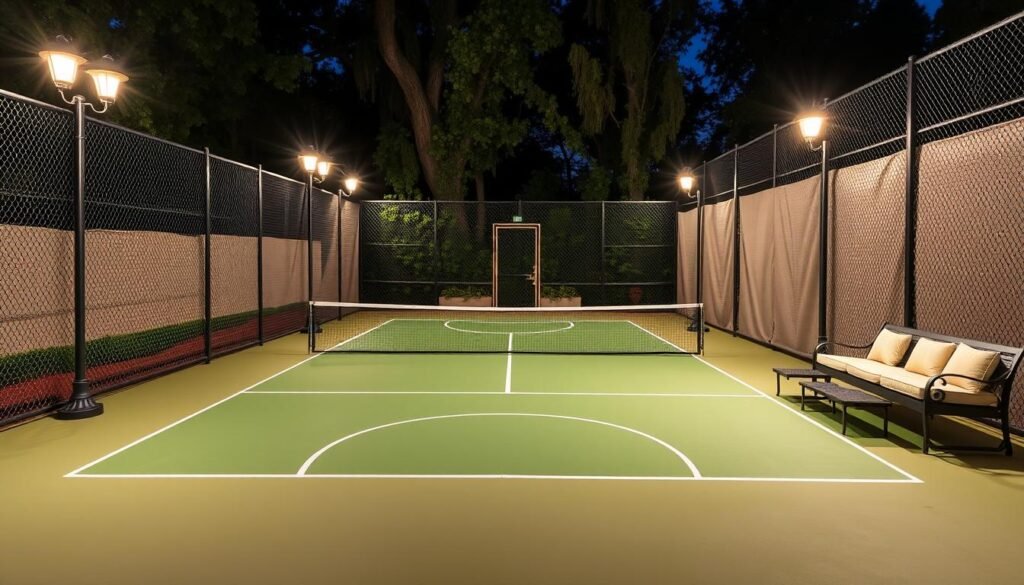
Fencing
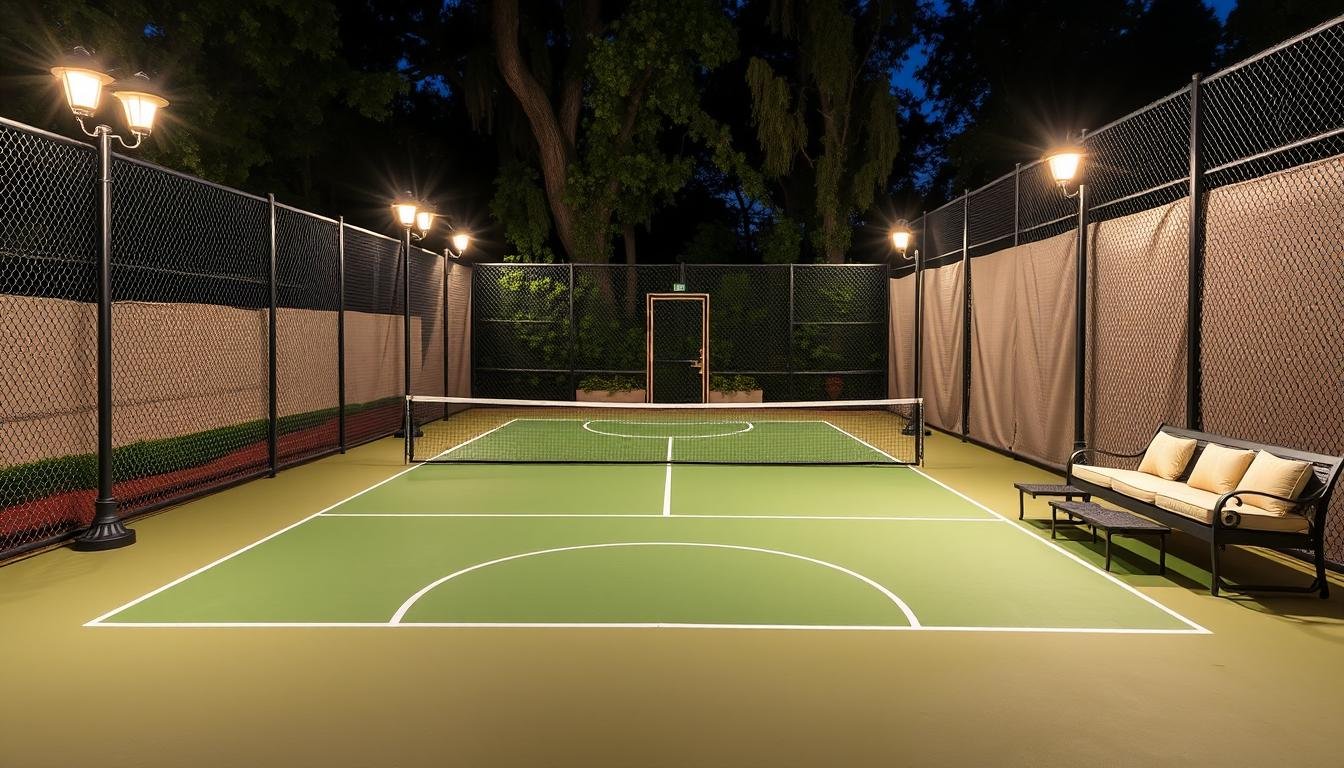
Go for chain-link or mesh for durability and clear views. Aim for 10–12 feet high to keep balls in. Use concrete footings for posts and add a gate for access.
Windscreens and wind protection
Windscreens on the fence reduce wind impact on open courts. They protect landscaping and keep balls off the street.
LED court lighting
LED lights provide bright, efficient light for night play. Check lumen needs and pole height before buying. Portable 13-foot LED units, like Alta Lighting 6,300-lumen options, are good for many setups.
Place lights to avoid glare. Use multiple poles or angled fixtures for even coverage without eye glare.
Seating, shade, and storage
Benches and shade like canopies or pergolas add comfort. Add storage for paddles and balls. A water cooler keeps players hydrated.
Small amenities
Scoreboards, non-slip mats, and paddle racks make play smoother. These extras enhance usability and finish your court.
| Upgrade | Typical Cost Range | Key Benefit | Installation Tip |
|---|---|---|---|
| Fencing for pickleball court (10–12 ft) | $1,200–$4,000 | Keeps balls in play; improves safety | Set posts in concrete footings; include a gate |
| Windscreen | $150–$700 | Reduces wind drift; adds privacy | Use wind-rated fasteners and tension straps |
| LED court lighting | $800–$6,000 | Enables night play; energy efficient | Plan pole height and aim to reduce glare |
| Benches and shade | $200–$2,000 | Comfort and sun protection | Anchor benches; orient shade for afternoon sun |
| Storage and accessories | $100–$800 | Organization and convenience | Choose weatherproof materials; secure to fence or wall |
Maintenance, Repair, and Cost Breakdown for a Homemade Pickleball Court
Keeping your homemade pickleball court in good shape saves time and money. Regular care stops small problems from becoming big ones. You need a simple plan for cleaning, inspections, and seasonal checks.
Routine care
Sweep the surface weekly to remove debris. Power wash every few months to get rid of grime and mildew. Check lines, net posts, and drainage after heavy rain. Good maintenance keeps the court safe and extends its life.
Crack repair and patching
Fix small cracks right away. Use concrete filler for small gaps and asphalt patching compounds for bigger breaks. Look for ponding water that signals drainage problems. Fixing drainage issues quickly prevents bigger problems.
Resurfacing timelines
Asphalt courts need resurfacing every 3–7 years, depending on climate and use. Concrete courts can last decades with the right care. Plan to repaint lines often if your court is used a lot.
Estimating project costs
Here’s a cost breakdown to help plan your pickleball court project. These numbers are typical in the U.S. and reflect common options.
| Item | Typical Cost Range (USD) | Notes |
|---|---|---|
| Permanent surface installation (concrete/asphalt) | $15,000–$45,000 | Concrete bids often $25,000–$35,000; local contractors may be lower |
| Painting (professional) | $8,000–$15,000 | Includes color coatings and line layout for regulation play |
| Painting (DIY materials) | ~$4,000 | Buy acrylic court coatings and tape; labor is your time |
| Lighting (per pole) | $2,000–$2,500 | LED fixtures reduce long-term energy costs |
| Portable LED lights | Under $500 each | Good for temporary night play and portable setups |
| Fencing | $1,500–$4,000 | Cost varies by height, material, and professional install |
| Portable net | $150–$400 | Easy setup, no digging required |
| Permanent net system | $500–$1,500 | Anchored posts for regulation stability |
Budget-saving strategies
Use an existing driveway or basketball court to save money. Painting lines and adding a portable net can be cheaper than a full install. Buy materials online during sales for lighting and fencing to cut costs.
DIY vs. professional work
Do painting and minor patching yourself to save thousands. Hire pros for excavation and concrete work to reduce risk and cost. Ask for references and check reviews for companies like Karim Construction or local landscapers when comparing bids.
Project timeline
A full build takes about six weeks, including excavation, concrete cure, painting, and finishing. Weather and contractor schedules can affect timing. Allow proper curing (28–60 days) before final coatings in some practices to ensure longevity.
When to call a pro
If you notice major cracking, sinking, or uneven play surface, schedule professional pickleball court repair. Structural issues beneath the surface require experienced contractors to diagnose and fix subbase problems properly.
Conclusion
Building a diy pickleball court in your backyard is doable with a solid plan. First, pick a flat, dry spot that faces north–south. Then, lay down a strong base with good drainage.
Let the concrete dry, check for moisture, and apply sport-grade coatings in thin layers. This protects the surface.
Decide if you want a permanent court or start with portable gear. A portable net and temporary lines help you play while you plan. Think about adding fencing, LED lights, and seats for better play and hosting.
Use the guide’s material and cost info to make a detailed plan. If needed, get quotes from different contractors. Focus on keeping the court dry, curing properly, and installing the net right. With careful prep and the right steps, you can create a fun, useful space for your family.
FAQ
What are the official pickleball court dimensions and line widths?
The court is 20 feet wide by 44 feet long. The lines, including the kitchen, must be 2 inches wide. They should contrast well with the court surface.
How much total space do I need for a backyard pickleball court?
You’ll need at least 30 feet by 60 feet for safety. For better play, aim for 40 feet by 64 feet. If space is tight, build a half court with correct line sizes.
Where should I place the court on my property and which orientation is best?
Pick a flat, level spot with good drainage. Face the court north–south to avoid sun glare. Also, consider the wind to reduce ball interference.
Can I convert an existing driveway or tennis/basketball court into a pickleball court?
Yes. Use a flat surface and mark lines. A portable net makes it a quick, low-cost option.
What are the base preparation steps for a permanent outdoor court?
Clear the area and dig 6–8 inches deep. Add a 4-inch gravel base for drainage. Then, pour a concrete slab with rebar for strength. Make sure it slopes slightly for water runoff.
Concrete or asphalt — which surface should I choose?
Concrete lasts longer but costs more. Asphalt is cheaper but needs resurfacing often. Both can be painted for better playability.
How long do I need to wait before painting newly poured concrete?
Wait 28–40 days for the concrete to cure. Sometimes, wait up to 60–70 days for moisture to fully dissipate. Always test for moisture before painting.
How do I handle moisture issues before coating the court?
Test for moisture. Use a moisture barrier if needed. Clean the surface before applying primer and paint.
What paints and colors work best for visibility and traction?
Use contrasting colors for the court and lines. Darker main color with a lighter kitchen color is recommended. Apply two thin coats for best texture.
How much paint do I need for a standard court?
Estimate 15 gallons for the court and 1 gallon for lines. Coverage varies by product, so check the specs.
What are the net dimensions and installation requirements?
The net is 22 feet wide, with 36-inch sidelines and 34-inch center. Posts are 22 feet apart. Use concrete for permanent posts or a portable net for flexibility.
Should I install permanent posts or use a portable net?
Portable nets are cheaper and more flexible. Permanent posts offer stability and a dedicated look. Choose based on your needs and budget.
What fencing and wind protection should I consider?
Use 10–12 feet high fencing to keep balls in play. Windscreens help with consistent play and prevent balls from straying.
What lighting options work for backyard courts?
LED sports lighting is bright and energy-efficient. Choose fixtures for even coverage without glare. Portable LED systems are affordable for evening play.
How often does a court need maintenance and resurfacing?
Clean and power wash regularly. Asphalt courts need resurfacing every 3–7 years. Concrete courts require occasional patching and repainting. Check for drainage and cracks often.
What are typical cost ranges for building a permanent court versus a DIY approach?
Permanent courts cost ,000–,000 or more. DIY options like repurposing driveways or using a portable net can save money and get you playing sooner.
What savings strategies can lower the overall project cost?
Repurpose existing surfaces and handle painting yourself. Seek multiple bids and buy online. Start with a portable net for immediate play.
Can I play on a half-court or practice court, and how does layout change?
Yes. Half courts are good for limited space. Keep the kitchen, service lines, and centerline accurate for proper gameplay.
What tools and products do I need for painting and finishing?
You’ll need a power washer, etch, and cleaner. Also, a moisture barrier, primer, court coatings, rollers, brushes, tape, and safety gear.
How long does the full build process take from excavation to playable surface?
The time varies by scope and weather. Excavation and concrete work take weeks. Concrete curing and moisture control can extend the timeline. A full build can take about six weeks or more.